
Disclaimer: The strategic and technical evaluations of SFMC presented in this analysis reflect independent architectural assessments of the marketing technology landscape. The findings synthesize market data, platform documentation, and advanced engineering paradigms to provide a comprehensive understanding of the ecosystem.
Deconstructing the Marketing Cloud Umbrella in 2026
The definition of Salesforce Marketing Cloud has undergone a profound transformation, evolving far beyond its origins as a standalone email delivery mechanism. By 2026, the nomenclature no longer refers to a singular application, but rather serves as a vast umbrella brand encompassing a highly diversified suite of digital marketing, analytics, multi-channel personalization, and automation products. This ecosystem is meticulously designed to orchestrate customer experiences across the entire customer lifecycle, effectively unifying the traditionally siloed domains of marketing, sales, service, and commerce.
To navigate this environment, enterprise architects and marketing leaders must distinctly categorize the platform into its core product pillars, each serving a highly specialized function within the broader technology stack. The primary components of this umbrella include Marketing Cloud Engagement, Marketing Cloud Account Engagement, Marketing Cloud Personalization, Marketing Cloud Intelligence, and the newly architected Marketing Cloud Next.
Marketing Cloud Engagement, historically known as ExactTarget, remains the flagship business-to-consumer platform, engineered for complex, high-volume, multi-channel campaign execution across email, SMS, push notifications, and advertising endpoints. Marketing Cloud Account Engagement, formerly Pardot, operates as the primary business-to-business marketing automation platform, focusing on lead generation, lead nurturing, and deep alignment with Salesforce Sales Cloud through integrated lead scoring and grading frameworks.
Beyond execution, the suite incorporates specialized analytics and decisioning engines. Marketing Cloud Personalization, previously Interaction Studio, delivers real-time, one-to-one personalization and recommendation decisioning across web and mobile app experiences, utilizing behavioral tracking to alter digital storefronts dynamically. Marketing Cloud Intelligence, formerly Datorama, functions as an advanced analytics platform that normalizes and visualizes marketing performance data from thousands of disparate external sources, allowing organizations to optimize return on advertising spend and execute cross-channel attribution modeling.
The most significant evolution in this portfolio is Marketing Cloud Next, which encompasses the Growth and Advanced Editions. This product represents a fundamental architectural shift, built natively on the Salesforce Core platform and powered by Data Cloud and Agentforce. It embodies the future of the company’s “agentic marketing” strategy, shifting the paradigm from manual rule-based automation to autonomous artificial intelligence orchestration.
The contemporary marketing landscape requires organizations to make a strategic choice between maintaining the highly customizable, code-heavy legacy platforms or adopting the newer, seamlessly integrated native solutions. Understanding the nuances of this choice requires a deep examination of market sentiment, underlying data architectures, and the specific functional disparities between these parallel ecosystems.
The Gartner Perspective: Market Leadership and Customer Reality
Strategic assessments of the marketing technology landscape consistently affirm the dominance of these platforms, yet they also reveal a complex dichotomy in user sentiment. As of September 2025, the Gartner Magic Quadrant for B2B Marketing Automation Platforms positioned Salesforce as a definitive Leader, recognizing the platform’s high capacity to execute and its completeness of vision within the market for software applications that support demand generation processes at scale. This leadership classification indicates that the platform successfully delivers mandatory market capabilities, such as inputting and synchronizing customer contact and account data into a unified customer profile, executing multistep journeys, and scoring leads using predictive analytics.
However, raw market leadership does not equate to universal operational ease. An analysis of Gartner Peer Insights reviews extending into 2026 reveals a polarized user base grappling with the platform’s immense power and its corresponding complexity. The platform maintains a favorable overall rating of 4.1 out of 5 stars based on an aggregate of 454 validated enterprise ratings, with 79 percent of users indicating a strong likelihood to recommend the software to their peers.
The primary strengths highlighted in these strategic reviews center around foundational artificial intelligence and deep data manipulation. The integration of Einstein AI features receives high praise, with users noting that the tools significantly reduce the manual effort required to analyze data in depth and understand complex customer behaviors. Consequently, the platform achieved a rating of 4.3 out of 5 for its Analytics and Foundational AI capabilities. Furthermore, the platform’s capacity for hyper-personalization remains its most celebrated asset, scoring an impressive 4.5 out of 5 for Personalization. Enterprise clients emphasize that the detailed data analysis features directly facilitate the creation of highly tailored digital activities and communications that resonate with targeted audiences.
Conversely, the platform faces significant criticism regarding its financial accessibility and the steep technical barriers required to achieve a return on investment. Pricing complexity is identified as a major pain point, with the platform’s overall cost metric rated 1.98 percent below the market average. The tiered subscription model, which scales based on feature ranges, user access, usage volume, and additional feature modules, leads some organizations to feel burdened by features they do not actively utilize. Multiple critical reviews explicitly describe the platform as extremely expensive, warning that organizations lacking deep technical expertise may find a positive return on investment virtually impossible to attain.
Usability and architectural complexity represent the other primary source of user frustration. The legacy user interface is frequently described as outdated, unfriendly, and slow to navigate. The ease of deployment, administration, and maintenance category received the lowest specific feature rating of 3.9 out of 5, underscoring the friction administrators face when configuring the system. Users specifically cite challenges when creating and managing complex workflows within Journey Builder, particularly when those journeys rely on highly segmented data extensions. Furthermore, despite the platform’s branding, users often report that the legacy architecture does not feel natively integrated with the core Salesforce CRM, leading to disjointed data management workflows.
This stark contrast in market sentiment—celebrating unparalleled personalization power while lamenting deployment complexity and integration friction—provides the exact strategic context for the introduction of Marketing Cloud Next. The newer native architecture is explicitly designed to alleviate the legacy complexity and disjointed user experience that has historically challenged users of the classic platforms.
The Architectural Divide: ExactTarget versus Core Data Cloud
To fully comprehend the operational differences between classic Marketing Cloud Engagement and the newer Marketing Cloud Next, one must examine the fundamental divide in their underlying data architectures. The acquisition of ExactTarget provided a remarkably powerful execution engine, but because it was constructed on an independent infrastructure, seamless data integration with the broader CRM ecosystem has historically necessitated complex engineering workarounds.
The legacy ExactTarget architecture operates on a highly flexible, proprietary relational database system relying extensively on Data Extensions. Data Extensions function as customizable tables that can be linked via foreign keys to form complex relational models. In this isolated environment, synchronizing data between Sales Cloud or Service Cloud and the marketing platform requires the implementation of Marketing Cloud Connect. This connector periodically polls the CRM and mirrors object data into Synchronized Data Extensions.
While this relational model offers virtually unlimited flexibility for experienced developers capable of utilizing scripting languages and SQL, it inherently creates data silos. The separation of databases means that marketers often spend excessive amounts of time acting as data engineers, building complex query activities, mapping relationships, and maintaining fragile integration pipelines simply to access core customer data. Furthermore, the synchronization process introduces data latency, limiting the platform’s ability to trigger immediate, real-time responses to events occurring natively in the CRM.
Marketing Cloud Next represents a total architectural rebuild, operating natively on the Salesforce Core platform and utilizing Data Cloud, increasingly referred to as Data 360, as its foundational data layer. This paradigm shift fundamentally eliminates the need for synchronization connectors and batch data mirroring.
The modern 2026 architecture replaces traditional Extract, Transform, Load processes with federated grounding and zero-copy architecture. By leveraging Data 360, Marketing Cloud Next can securely access and query external datasets residing in platforms like Snowflake, Databricks, or BigQuery in real-time, entirely eliminating the need to duplicate massive data volumes into Salesforce storage. This zero-copy strategy allows artificial intelligence models to reason across a federated data estate while maintaining strict security protocols through the Einstein Trust Layer.
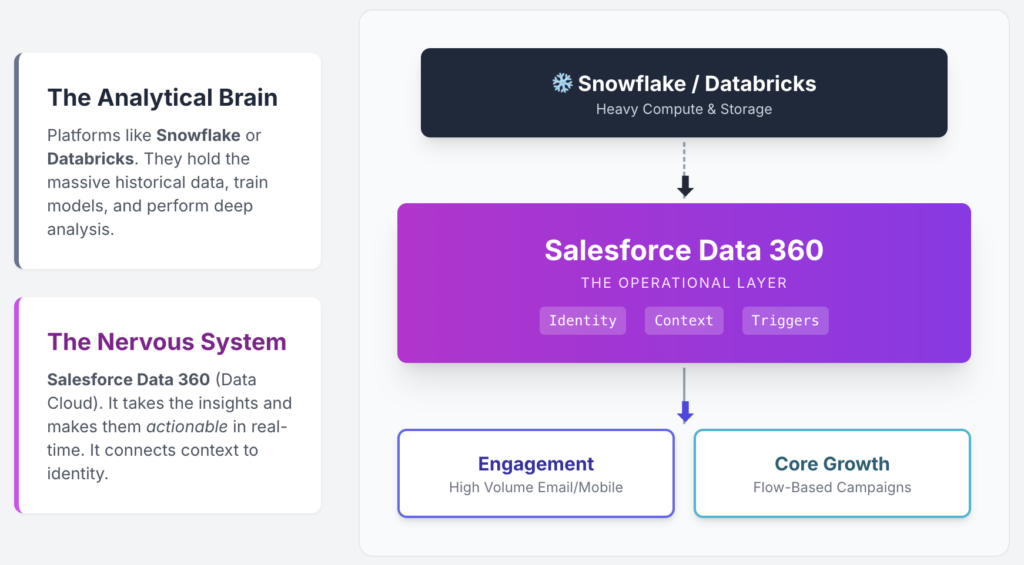
Within the platform, the architecture utilizes standard Salesforce objects alongside unified Data Model Objects. Instead of managing separate, disconnected records for a single individual across different channels, the system utilizes Identity Resolution Rulesets to deterministically and probabilistically match multiple identifiers: such as an email address, a mobile device ID, and a loyalty account number, into a single Unified Individual profile. This unified architecture ensures that marketing, sales, and service teams are universally accessing the exact same customer record in real-time, effectively shifting the marketer’s role from managing data plumbing to focusing entirely on strategic performance.
Marketing Cloud Engagement: The Enduring Technical Powerhouse
Despite the rapid innovation surrounding the native Core platforms, the classic ExactTarget-based Marketing Cloud Engagement remains an indispensable component of the ecosystem in 2026. Market analysis clearly indicates that executing a forced migration of large enterprise customers off a platform so deeply embedded in their daily operations is neither technically feasible nor strategically desirable in the short term. The classic platform retains distinct operational advantages for highly technical engineering teams and global enterprises requiring unparalleled customization and high-volume processing capabilities.
Advanced Infrastructure Management
Marketing Cloud Engagement is uniquely battle-tested for global enterprises transmitting hundreds of millions of commercial messages. The platform provides systems architects with intricate, granular control over email deliverability, which is defined not merely as messages sent, but as the critical metric of actual inbox placement.
Enterprise deployments rely on the Sender Authentication Package, a comprehensive branding tool that bundles a private domain, a dedicated IP address, and specialized link and image wrapping to ensure that every URL within a communication reflects the brand’s authenticated domain rather than generic tracking links. For organizations requiring multiple sender identities, the platform allows the configuration of supplementary Private Domains, though managing DMARC alignment across these domains necessitates the activation of multi-bounce domain routing to ensure the technical return-path aligns perfectly with the visible sender address.
Programmatic Customization and Scripting Flexibility
For engineering teams, the primary value of the classic platform lies in its support for proprietary scripting languages, which allow for the dynamic rendering of content at the exact moment of an email open. AMPscript provides deep personalization capabilities, enabling marketers to look up relational data arrays, execute conditional logic, and manipulate string formats directly within the email HTML. Experienced developers optimize processing speeds by substituting resource-heavy functions with bulk retrieval methods, ensuring that campaigns targeting millions of subscribers execute without latency.
The platform supports sophisticated impression tracking mechanisms through specialized AMPscript functions, which register exactly which dynamically rendered content blocks a specific subscriber viewed and engaged with. This level of granular tracking is absolutely vital for organizations that generate dozens of potential email permutations based on real-time loyalty tiers and demographic data, as it allows them to report accurately on the performance of highly individualized offers.
Server-Side JavaScript expands this flexibility further, allowing architects to execute complex programmatic operations, parse extensive JSON payloads, and interact directly with the platform’s REST APIs. A prime example of this extensibility is the utilization of Cloud Page Code Resources as headless API endpoints. By deploying Server-Side JavaScript within a code resource, engineers can capture real-time data payloads from external web forms, validate the input, and asynchronously distribute the data across multiple relational data extensions, effectively building robust, custom consent management and preference center architectures that operate entirely independently of standard CRM integrations.
Relational Data Processing and Automation Studio
Automation Studio within Marketing Cloud Engagement remains an unparalleled powerhouse for backend data transformation and batch processing. The system allows marketers to utilize complex SQL Query Activities to join, flatten, and synthesize vast arrays of behavioral data, transforming highly normalized CRM data into flattened, actionable sendable audiences.
Navigating the nuances of the platform’s SQL environment requires deep expertise, particularly regarding system time management. Because the core database operates strictly on a UTC-6 system time, engineers must utilize specific SQL functions to convert event timestamps accurately into local time zones, ensuring that behavioral triggers and segmentation logic align with the customer’s actual chronological experience. The ability to execute raw SQL against tables containing tens of millions of records provides a level of data manipulation and operational scalability that low-code, drag-and-drop tools cannot yet fully replicate.
Marketing Cloud Next: Growth and Advanced Editions
Marketing Cloud Next is strategically brought to market through distinct product tiers, primarily the Growth Edition and the Advanced Edition. While both tiers share the same underlying Data 360 infrastructure and operate natively within the CRM user interface, they cater to fundamentally different levels of organizational maturity and marketing sophistication.
Marketing Cloud Growth Edition
Positioned as the entry point for organizations seeking to modernize their marketing operations on the core platform, the Growth Edition is optimized for small to mid-sized teams that require highly efficient, straightforward marketing automation without the overhead of maintaining complex relational databases.
The operational focus of the Growth Edition centers on core multi-channel campaign execution, providing native support for foundational communication channels including email, standard SMS, social media, and basic web marketing. Instead of utilizing the legacy Journey Builder interface, the Growth Edition leverages Salesforce Flow to orchestrate marketing activities. This integration is profound, as it allows multi-channel marketing journeys to trigger immediately based on native CRM record changes, eliminating the latency historically associated with external synchronization.
The Growth Edition includes essential artificial intelligence and segmentation features. Marketers can utilize generative AI to draft content and rely on standard Einstein Send Time Optimization to deliver messages when recipients are most likely to engage. Data Cloud powers demographic and engagement-based segmentation, while People Scoring allows organizations to prioritize leads based on individual behavioral and profile-based criteria.
Marketing Cloud Advanced Edition
The Advanced Edition is engineered for large enterprises and high-growth brands that demand deep predictive intelligence, rigorous experimentation capabilities, and highly sophisticated orchestration tools. This tier unlocks the full potential of the Data 360 foundation, providing advanced functionalities that push beyond basic automation into continuous, autonomous optimization.
A critical differentiator of the Advanced Edition is the integration of predictive AI engagement models directly into the orchestration engine. Einstein Engagement Scoring and Einstein Engagement Frequency operate natively within Salesforce Flow. This predictive intelligence empowers the system to autonomously suppress communications for individuals identified as having a high risk of unsubscribing, prioritize specific promotional offers for highly engaged scorers, and automatically throttle messaging cadences to prevent audience fatigue.
Furthermore, the Advanced Edition introduces sophisticated Path Experimentation, moving significantly beyond simple manual splits by allowing marketers to run complex, multivariate tests with up to ten distinct variations directly within a Flow, automatically declaring and routing traffic to the winning path based on real-time performance.
The platform also expands its communication capabilities to include two-way SMS, mobile push notifications, and emerging messaging channels like WhatsApp. This is enhanced by Unified Conversations functionality, which ensures that customer replies to SMS or WhatsApp messages do not hit a dead end; instead, the system can interpret the intent of the reply, resume Flow logic accordingly, or seamlessly transition the interaction to a human service agent.
For business-to-business organizations, the Advanced Edition provides comprehensive Account Scoring, which aggregates engagement, fit, and intent data across all unified individuals within a single business account, enabling highly targeted, account-based marketing strategies driven by overall account health.
Feature Matrix Comparison
| Capability Domain | Marketing Cloud Growth Edition | Marketing Cloud Advanced Edition |
| Target Demographic | Small to mid-sized organizations | Enterprises and high-growth brands |
| Architectural Foundation | Salesforce Core and Data Cloud | Salesforce Core and Data Cloud |
| Orchestration Engine | Salesforce Flow | Enhanced Salesforce Flow |
| Supported Channels | Email, basic SMS, Social, Web | Email, 2-Way SMS, WhatsApp, Push Notifications |
| Testing Methodology | Manual split testing, static rule definitions | Automated Path Experimentation (up to 10 variants) |
| Artificial Intelligence | Generative content drafting, Send Time Optimization | Agentforce Campaign Designer, Einstein Engagement Scoring, Einstein Engagement Frequency |
| Prioritization Framework | People Scoring (Individual level analysis) | People Scoring and Unified Account Scoring (ABM) |
| Conversational Dynamics | Standard outbound messaging broadcasting | Unified Conversations with AI-to-human handoff |
The Agentic Era: Agentforce in Marketing
The defining technological advancement in the 2026 marketing ecosystem is the profound transition from basic generative AI to agentic AI. While previous iterations of artificial intelligence functioned primarily as passive assistants requiring meticulous, step-by-step human guidance and prompt engineering, the autonomous AI agents embedded within the Salesforce ecosystem, branded as Agentforce, operate as independent digital workers. These agents are capable of reasoning, planning, and executing highly complex tasks within defined strategic guardrails, fundamentally altering how marketing operations are scaled.
Conversational Email and the End of the “No-Reply”
Historically, marketing emails operated strictly as one-way broadcasts, typically sent from unmonitored “no-reply” addresses that actively discouraged customer interaction. The Spring 2026 release revolutionized this paradigm with the introduction of Conversational Email, previously termed Two-Way Email. This capability utilizes Agentforce to actively manage and interpret replies to mass marketing broadcasts.
If a customer replies to a promotional email inquiring about product sizing, shipping delays, or warranty information, the AI agent instantly interprets the semantic intent, queries the Salesforce CRM and relevant Data 360 knowledge bases via Retrieval-Augmented Generation (RAG), and provides a highly personalized, contextual response directly within the email thread. This transforms a static promotional blast into a dynamic, two-way dialogue, effectively deflecting support cases and guiding high-intent customers toward conversion without necessitating human intervention.
Campaign Orchestration and Journey Decisioning
In the classic marketing automation model, professionals were required to manually plot every decision branch, wait step, and logical split within a visual journey builder. Agentforce introduces Journey Decisioning Agents that operate dynamically within Marketing Cloud Next. Rather than relying on rigid, predefined flowcharts, these agents continuously analyze real-time Data Cloud signals and historical behavioral profiles to autonomously decide the optimal next step, message, or channel for each individual user.
Additionally, the Agentforce Campaign Designer completely streamlines campaign assembly. Marketers can upload external strategy documents, such as a PDF brief or a Word document, or provide a simple natural language prompt. The agent subsequently digests this context, drafts a comprehensive campaign strategy, generates the required email and SMS copy perfectly aligned with the brand’s established tone of voice, builds the target audience segments, and automatically constructs the multi-channel flow structure for the marketer to review and approve.
Autonomous Paid Media Optimization
The operational burden of managing cross-channel advertising is significantly reduced by the Agentforce Paid Media Optimization agent. Operating continuously in the background, this agent monitors advertisement performance across external platforms such as Google and Meta. Rather than waiting for an analyst to review a dashboard days after a campaign launches, the agent autonomously identifies underperforming segments, pauses ineffective advertisements, and reallocates budget and messaging strategies in real-time based strictly on marketer-defined business goals and return-on-ad-spend thresholds.
The Convergence Strategy: Marketing Cloud Engagement+
Recognizing that a forced migration from the deeply entrenched ExactTarget architecture to the native Core platform would severely disrupt the complex operations of its largest enterprise clients, Salesforce has meticulously executed a strategy of convergence rather than outright replacement. This strategic bridge is manifested in the Engagement+ and Account Engagement+ licensing tiers.
Marketing Cloud Engagement+ is a hybrid upgrade that permits existing legacy users to access the powerful agentic capabilities and native Data 360 infrastructure of Marketing Cloud Next without requiring them to abandon their established ExactTarget data models, complex AMPscript templates, or finely tuned IP deliverability reputations. The operational philosophy guiding this convergence is accurately summarized as “Keep What Works and Add What’s Next”.
A primary feature of this convergence is the enablement of cross-platform orchestration. Marketers can utilize the modern, data-rich environment of Salesforce Flow on the core platform to orchestrate the timing, audience selection, and decisioning logic of a campaign, while utilizing the legacy Marketing Cloud Engagement engine to execute the actual email deployment. This allows organizations to leverage real-time Data Cloud triggers while retaining their highly customized, code-heavy execution assets.
To manage this hybrid environment, the platform introduces the Digital Wallet, a unified, self-serve dashboard that provides administrators with total visibility into messaging credit consumption across both the legacy and next-generation environments, breaking down usage by channel, business unit, and destination country. Furthermore, the system includes robust data compatibility enhancements, allowing legacy engagement metrics to be seamlessly merged into unified marketing performance dashboards on the core platform. This convergence extends to privacy management, featuring automated consent matching that synchronizes opt-out preferences across Account Engagement prospects and Marketing Cloud Next records to ensure strict regulatory compliance.
The Spring 2026 release cycle significantly accelerated this convergence by introducing critical enterprise-grade features directly into Marketing Cloud Next. The platform officially deployed Business Unit functionality, allowing massive global organizations to partition their data, campaigns, and user access across up to 50 distinct, secure workspaces, entirely eliminating the risk of data leakage between regional brands. Additionally, Marketing Cloud Next now natively supports dedicated IP configurations, finally allowing high-volume B2C senders to manage and protect their own specific sender reputations without relying on the legacy engagement infrastructure.
Strategic Engineering and Data Virtualization
As the platform ecosystem becomes increasingly interconnected, the role of the technical marketing professional must evolve from a tactical script writer to a strategic domain architect. This requires a deep understanding of data virtualization, secure API integrations, and the creative utilization of headless platform capabilities.
While native integrations provide seamless data flow, enterprise architects frequently encounter scenarios where moving massive volumes of transactional data physically into the CRM is cost-prohibitive or technically inefficient. To solve this, architects employ advanced data virtualization techniques, such as utilizing Lightning Web Components integrated directly into Sales Cloud record pages. Instead of replicating millions of marketing engagement records into the CRM storage, a Lightning Web Component can execute a real-time callout to a custom JSON Code Resource hosted on Marketing Cloud Engagement.
This code resource, powered by Server-Side JavaScript, dynamically queries the relevant engagement data extensions based on the specific Lead or Contact ID, formats the response into a secure JSON payload, and returns it to the CRM interface instantaneously. This architectural pattern provides sales representatives with immediate, high-fidelity visibility into a prospect’s marketing interactions without incurring the massive storage costs or synchronization delays associated with traditional ETL data replication.
Furthermore, the extensibility of the legacy platform allows architects to securely ingest external behavioral data. By deploying sophisticated script-based listeners, organizations can capture intent signals from external tag managers, validate origins and API keys securely, and asynchronously process massive payloads into relational databases. This decoupling of identity resolution from immediate data ingestion ensures that the platform can absorb high-velocity web traffic without encountering performance bottlenecks, staging the data perfectly for eventual activation by Agentforce models or Data Cloud segments.
Conclusion: The SFMC Future of the Agentic Ecosystem
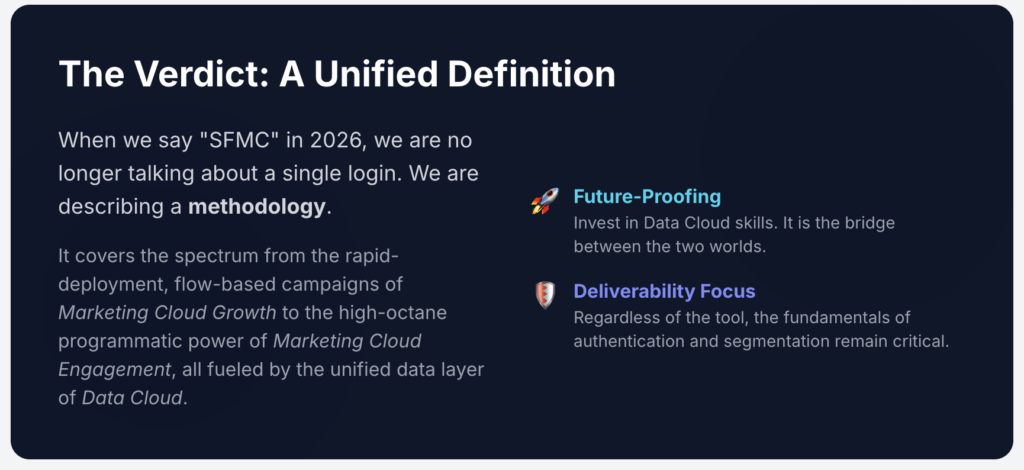
In 2026, the term SFMC encapsulates two distinct, highly capable, and rapidly converging architectural realities. Marketing Cloud Engagement stands as the enduring, technically robust execution engine, offering unparalleled scripting flexibility and granular deliverability control for the world’s most complex enterprise deployments. Concurrently, Marketing Cloud Next represents the modern, native-to-core evolution, leveraging the vast power of Data 360 and the autonomous reasoning capabilities of Agentforce to democratize advanced orchestration and eliminate historical data silos.
The strategic trajectory dictated by Salesforce clearly indicates that a forced, disruptive migration away from the legacy architecture is not imminent. Instead, the introduction of the Engagement+ tier provides a pragmatic, hybrid pathway. This allows sophisticated marketing organizations to retain their substantial investments in custom relational models and execution assets while systematically layering on the transformative power of real-time data unification and agentic artificial intelligence.
For marketing leaders and system architects, the imperative is definitive. The era of dedicating vast resources to manual data plumbing, fragile synchronization pipelines, and static SQL segmentation is rapidly concluding. The ultimate competitive advantage now resides in the ability to establish rigorous data hygiene, implement unified cross-cloud identity resolution, and strategically deploy autonomous agents to drive deeply personalized, real-time customer experiences across the entire digital lifecycle.